Mindat Millet & Pork Stew
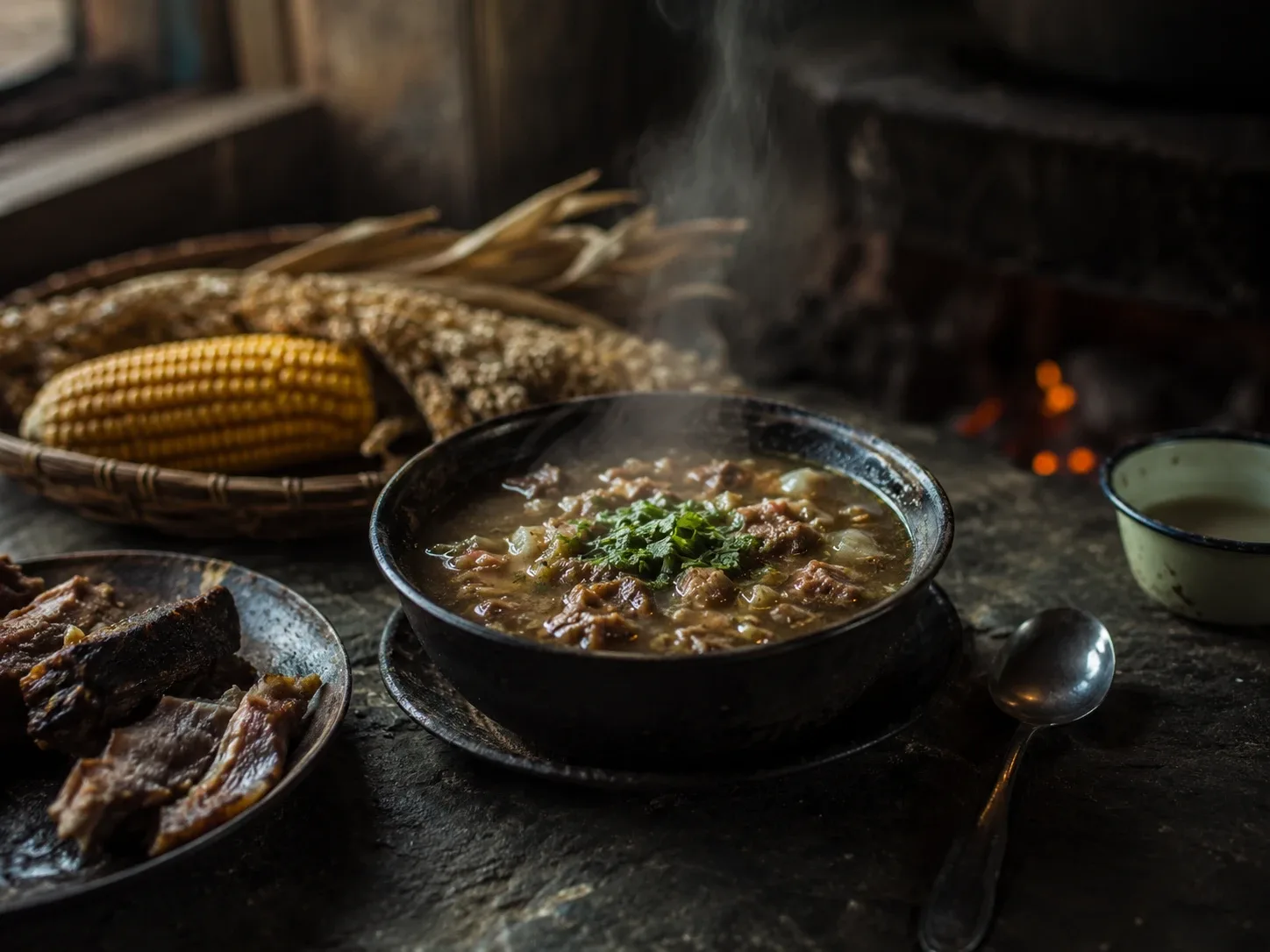
Mindat's famous one-pot stew — pork simmered until tender, then thickened with finger millet, the Chin hills' oldest grain doing quiet work in a smoky broth.
By Burmese Cookbook Kitchen · July 9, 2026
ချင်း Chin HillsBritish Burma, 1826–1948
 ၅
၅- Prep
- 15 min
- Cook
- 90 min
- Serves
- 6
- Level
- Beginner
Mindat, high in the southern Chin hills, is millet country. Every family farm keeps a plot of the small red-brown grain, and most of the harvest has one glorious destination: khaung, the millet beer that anchors K'cho festivals, brewed here from millet where the rest of the country brews from rice. But the field feeds the table before it feeds the jar — and the town's most famous dish is this one, pork simmered tender and then thickened with finger millet until the broth turns to a loose, earthy porridge that eats like a meal because it is one.
The record deserves honesty. Millet is almost certainly the hills' oldest staple — it was feeding these ridges before American corn arrived and took over the lower fields — and when colonial surveyors first wrote the Chin hills down at the end of the nineteenth century, millet stood among the crops they listed. The stew itself, though, lives in oral tradition and on Mindat's tables, entering print only through recent travel writing. We date the dish by its paper trail's beginning and trust the grain to testify to something much older.
The technique to respect is the pour. Millet rained slowly into a stirred, simmering broth thickens it evenly; millet dumped in a heap clumps like badly made polenta and never recovers. After that, the pot asks only for a spoon along the bottom every few minutes and salt at the end — mountain cooking's usual bargain of patience over pantry.
Millet sinks and sticks. Once the grain is in, your spoon lives in the pot — a scrape along the bottom every few minutes is the difference between stew and scorch.
မီးဖိုချောင်စကား · A word from the kitchen
Ingredientsပါဝင်ပစ္စည်း
Serves 6
Tap to check off as you gather
For the pot
- pork shoulder — with some fat, cut into large chunks; replacing half with smoked pork is common and very good
- water
- fresh ginger — sliced into coins
- garlic — smashed
- small onion — halved through the root
- finger millet — sold as ragi at Indian grocers; whole foxtail or proso millet works with a paler, milder result
- salt
To finish
- spring onions — sliced
- dried chili flakes — at the table, for those who want it
Methodချက်နည်း
Tap a numeral as you finish each step
Step 1: Simmer the pork first
Bring the pork and water to a boil in a heavy pot, skim the foam, then add the ginger, garlic, and onion and settle into a lazy simmer, partly lidded, for about 45 minutes. The meat should be tender but not collapsing — it still has half an hour of company ahead of it.
Step 2: Rinse the millet
While the pork cooks, rinse the millet in a fine sieve under cold water until the water runs nearly clear. Millet carries a fine field dust that can turn the broth muddy and faintly bitter; thirty seconds at the tap buys a cleaner pot.
Step 3: Rain the grain in
Scatter the millet into the simmering broth in a slow stream, stirring as you pour. Dumped in a heap it seizes into dumpling-like clumps the way polenta does — rained in, every tiny grain swims free and thickens the pot evenly.
Step 4: Simmer until the grain bursts
Cook at a gentle simmer for 30 to 40 minutes, dragging your spoon along the bottom every few minutes. The millet is done when the grains have burst and the broth has thickened to a loose porridge that falls lazily off the spoon. If it tightens past that, loosen it with a cup of hot water — the grain keeps drinking as it sits.
Step 5: Season and serve steaming
Stir in the salt, taste, and stop; if half the pork was smoked, you will need less than you think. Ladle into deep bowls, making sure everyone gets meat, and finish with spring onions, chili flakes on the side. In Mindat this is supper entire — no rice required, because the grain is already in the bowl.
ခွက်ယောက် · The tools
Equipment
Heavy pot / Dutch oven
အိုးကြီးDeep and heat-retentive — for mohinga broth, long-simmered hin, and deep-frying without temperature crashes.
Shop on Amazon →Fine sieve / muslin
စစ်ခွက်For straining tamarind, pressing broth clear, and sifting flours — line it with muslin for the cleanest pour.
Shop on Amazon →
Equipment links are Amazon affiliate links. As an Amazon Associate we earn from qualifying purchases, at no cost to you. Disclosure.
ဟင်းစုံ · Set the table
A Burmese meal is a spread
A Burmese soup sits beside the rice, not on its own. Set the table with:
- Steamed riceထမင်းThe centre of the table — everything else is built around it.
- A curryဟင်းSlow-cooked until the oil returns — the richness the sides cut against.
- Toh sa yar & ngapi dipတို့စရာRaw and blanched vegetables with a pungent fish-paste dip — the fresh, bitter counterpoint.
- Balachaungဘလချောင်းThe crispy shrimp relish that lives on every Burmese table.
- Crispy fried shallotsကြက်သွန်ကြော်A spoonful of crunch and sweet shallot oil over anything.
Questions from the kitchen
What exactly is finger millet, and where do I find it?
A small, red-brown mountain grain, one of the oldest cultivated in Asia, and the pride of Mindat's fields. Indian grocers sell it as ragi, usually whole or as flour — you want whole grain here. Foxtail or proso millet from a health-food aisle cooks up paler and milder but keeps the spirit; pearl barley is a different animal, chewier and slower.
Can I make it with chicken instead of pork?
Yes — bone-in chicken pieces make a lighter, entirely respectable pot; give them 30 minutes rather than 45 before the millet goes in. What chicken cannot supply is the fat that carries the grain's earthiness, so leave the skin on and skim less than your instincts suggest.
My stew turned gluey overnight. Did I ruin it?
No — millet, like besan in mohinga, keeps thickening as it cools, and a refrigerated pot sets nearly solid. Reheat it gently with a cup or two of hot water, stirring from the bottom, and it returns to itself. Many Mindat households would tell you the second day, re-loosened, is the better bowl.
နောက်တစ်ခု · Cook next
Keep the wok hot
 ၅
၅Soups & Broths · 135 min · Beginner
An Buti, the Meatless Corn Soup
Sabuti's meatless sibling from the Chin hills — hominy corn simmered with red beans, pumpkin, and greens until the pot thickens into gentle, vegetable plenty.
 ၅
၅Soups & Broths · 55 min · Intermediate
Ar Pu Shar Pu, the Burning-Mouth Bowl
Sittwe's famous hot-and-sour seafood soup — fish, prawns, and squid in a tamarind broth pounded through with green chilies, finished with lime and herbs.
 ၅
၅Soups & Broths · 165 min · Beginner
Sabuti, the Chin Corn Soup
The Chin hills' great corn soup — hominy maize simmered slowly with smoked pork and ginger, frugal mountain cooking that somehow eats like plenty.